Evaluating the true societal impact of universities remains an elusive challenge?
Counting graduates, publications, or patents is relatively easy. Capturing how universities change their regions, communities, and cultures is not. The Third Mission rarely fits into traditional metrics, leaving much of a university’s most meaningful work invisible or undervalued in conventional rankings.
ACEEU exists precisely to make this impact visible, credible, and comparable. Rather than adding another ranking or scorecard, ACEEU provides an independent, standards-based accreditation that evaluates how institutions intentionally design, govern, and embed engagement and entrepreneurship across their entire organisation.
Our accreditation framework translates achievements into structured, evidence-based qualitativeassessments. It looks not only at what universities do, but how and why they do it—examining Third Mission strategy, institutional culture, ecosystem relationships, governance, incentives, and long-term societal impact. Peer review by experienced international experts ensures depth, credibility, and learning—not box-ticking. In short, ACEEU goes beyond measuring outputs alone—it validates institutional maturity, purpose, and impact, enabling universities to lead societal transformation with evidence, confidence, and recognition.
At ACEEU, 2025 has also been a year of turning activity into impact: 6 new and 19 ongoing EU projects bring new insights, 4 awarded accreditations celebrate international excellence, more than 77 Triple E Awards recognise achievements across the globe, 1 international event brought together 150+ attendees, 3 new team members shape ACEEU’s future, and a book publication sheds light on often overlooked regions! The ACEEU Team travelled to over 12 countries this year for events, trainings, and project meetings, getting to know new and exciting people and deepening long-standing partnerships.
We would like to wish everyone a wonderful end to 2025 and a healthy and prosperous 2026.
Projects
ACEEU is your partner for quality assurance in project implementation. To date, we have supported 34 projects, applying a structured and independent evaluation approach grounded in the OECD evaluation framework (2021). Our methodology is built around four core criteria—relevance, efficiency, effectiveness, and impact—ensuring that project activities, outputs, and outcomes meet the highest quality standards and deliver measurable value.
PeerCollab embeds Peer Assessment to foster collaboration, critical thinking, and shared learning, linking pedagogical innovation with social engagement and impact-oriented quality in higher education.
Ethical Engineer integrates ethical AI into engineering education, fostering responsible innovation, societal trust, and value-driven engineering aligned with Europe’s social, legal, and ethical standards.
SMARTIE promotes inclusive, ethical AI teaching and assessment practices, fostering digital innovation, accessibility, and integrity in education aligned with European values and sustainable development goals.
EDU4SDGs advances empathy-driven, socially responsible education that fosters emotional intelligence, sustainability competencies, and transformative learning aligned with the UN Sustainable Development Goals.
ACEEU's accreditation framework comprises 15 standards that assess how universities deliver on their Third Mission. The Impact standard specifically evaluates the direct and indirect benefits academic units generate for their communities, including contributions to social cohesion, well-being, sustainability, and cultural life. Explore the full framework in our toolkit.
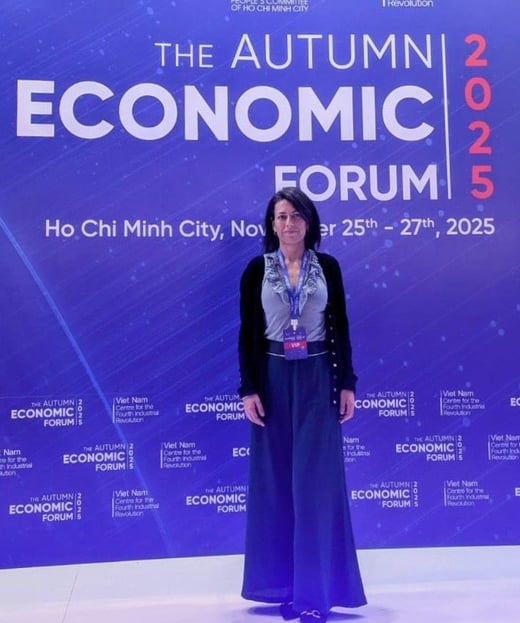
Autumn Economic Forum
ACEEU was honoured to participate in the Autumn Economic Forum 2025 in Ho Chi Minh City. Under the theme “Green Transition in the Digital Era”, our CEO Dr. Lina Landinez shared our vision that sustainable transformation requires true integration of systems, partners, and capabilities. Universities must become genuine enablers of societal and economic impact, and ACEEU is proud to support institutions ready to lead this change.
With AI-assisted proposal writing driving submissions to record highs (e.g. CBHE applications are up 58% in just one year), reviewers are scrutinising consortium quality more than ever. Strong partner complementarity and credibility now make or break applications.
ACEEU and its spin-off organisations, EFSI (European Future Skills Institute) and EDGE (European Digital and Green Education Alliance), are open to joining competitive proposals. Each organisation brings distinct expertise in quality assurance, future skills, and digital, green education.
Key 2026 Deadlines
Capacity Building
Feb 10HE • Mar 26VET
Cooperation Partnerships
Mar 5 HE, Adult, VET, Youth, Sports
Alliances for Innovation
Mar 10including new Lot 3:
STEM Skills Foundries with entrepreneurship education focus
Get in touch!
Reach out early—we evaluate invitations carefully to ensure meaningful contributions to each consortium.
ACEEU's Spotlight Magazine showcases high-quality initiatives through the stories of Triple E Award finalists. Read the latest articles to see true community engagement and social impact, and get inspired to make higher education more meaningful.
School on an Island
Mahin Hossain and ChowdhuryMujib share how the Kolcondo Campus is transforming a remote island by providing education, vocational training, and community development through NGO–university partnerships, empowering children, youth, and women while fostering sustainable, locally rooted change.
Zaur Samadov asks a simple but persistent question: why does entrepreneurship still feel out of place in so many disciplines? He explores how universities can reshape institutional culture, across teaching, learning, and disciplinary identities, so entrepreneurship becomes an integral part of the institution.
Accreditation Council for Entrepreneurial and Engaged Universities (ACEEU), Wilhelm-Schickard-Straße 14, Münster, North-Rhine-Westphalia 48149, Germany


.png)



.png)