Employers worldwide continue to see gaps in complex problem-solving in their workforce: analytical and creative thinking top the skills they need through 2030, amid rising skills disruption. In Australia, the ACS Digital Pulse 2025 report warns that this shortage of job-ready graduates is holding back national productivity; closing the gap could unlock more than $25 billion in growth. For higher education leaders, this is a strategic concern. It goes to institutional credibility and graduate employability. Work-integrated learning - real partner projects embedded in the curriculum - is a clear lever for building the capabilities employers want through genuine industry and community engagement.
At the University of Canberra, every final-semester student in all Information Technology degrees - both undergraduate and postgraduate - undertakes the ITS Capstone Program. Around 80% are international students, bringing diverse perspectives and preparing them for their future multicultural workplaces. This exemplifies ACEEU standard Education - involving external stakeholders in shaping what students build, how they work, and how outcomes are tested against real partner needs.
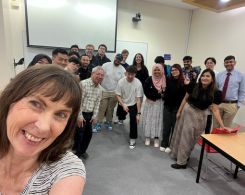
In Capstone, students work in small teams on projects offered by industry, government, or community sponsors. From the outset, we encourage students to take ownership and their enthusiasm builds. In just 12 weeks, they tackle complex, real-world problems and deliver solutions. Projects span technology, government, start-ups, and not-for-profits. Students choose projects aligned with their skills and aspirations, ensuring relevance for them and value for sponsors.
What makes the model distinctive is the dual mentorship structure: each team is guided by an academic mentor (ensuring scholarly rigour) and an industry or government mentor (bringing workplace expectations and real-world unpredictability). The result is a carefully scaffolded environment where students are expected to perform to professional standards, but with the support to succeed.
“Embedding external engagement into the core of the curriculum—is what closes the skills and knowledge gap,” says Associate Professor Ahmed Imran, Co-Convenor of the ITS Capstone Units. “Students don’t just acquire technical expertise; they graduate with much sought-after transformative skills including confidence, resilience, and professional judgement that today’s employers demand.”
A Community of Partners
The program builds a genuine community across government agencies, global firms, start-ups, and not-for-profits, a key building block for the ACEEU Standard of Service Alignment. Since 2019, more than 2,500 students have delivered over 500 projects. These projects are not one-offs - they reflect an embedded partnership model, with sponsors involved in shaping briefs, mentoring teams, and returning over time. That strategic approach aligns with UC’s recently released Reconnected framework and ACEEU Standard Influence within the ecosystem.
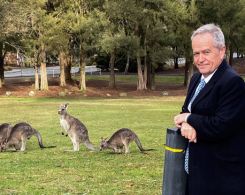
One example is SmartGate, co-designed with OpenSI using open-source technology. Using inexpensive sensors and AI, SmartGate distinguishes between species - allowing endangered native wildlife to pass while blocking predators such as foxes and feral cats. The solution has won national awards for innovation, showing how student innovation can scale into real-world conservation tools.
Another project supported Her Kitchen Table, a social enterprise helping culturally diverse women start food businesses. A Capstone team built a digital system to manage orders and inventory, freeing entrepreneurs to focus on cooking and growing sales. Students saw firsthand how technology can empower community enterprises.
International engagement is also offered. Students collaborate with Sri Ramakrishna Engineering College in India, developing cross-cultural teamwork skills and exposure to emerging technologies.
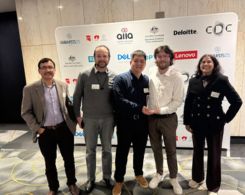
Capstone also fosters entrepreneurial mindsets. Teams have competed successfully in the national AIIA iAwards and Canberra’s InnovationACT entrepreneurship competition, where they refine business ideas, pitch to panels, and test innovations in a competitive marketplace.
“What makes Capstone distinctive is that projects are rooted in authentic community and industry needs,” explains Assistant Professor Richa Awasthy, Co-Convenor of the ITS Capstone Units. “That’s why our sponsors keep coming back, and why our students gain such powerful experience.”
Shared Ownership and Sustainable Engagement
Projects are co-created with sponsors, ensuring shared ownership. Industry mentors work alongside academics, blending commercial relevance with scholarly rigour.
This partnership benefits both sponsors and students. Guiding a Capstone team offers junior staff valuable leadership experience, improving outcomes for students while strengthening the sponsor’s own workforce capability.
Some projects, like SmartGate, are handed across cohorts, each team building on previous work. This continuity delivers long-term value for sponsors and gives students the satisfaction of contributing to lasting impact.
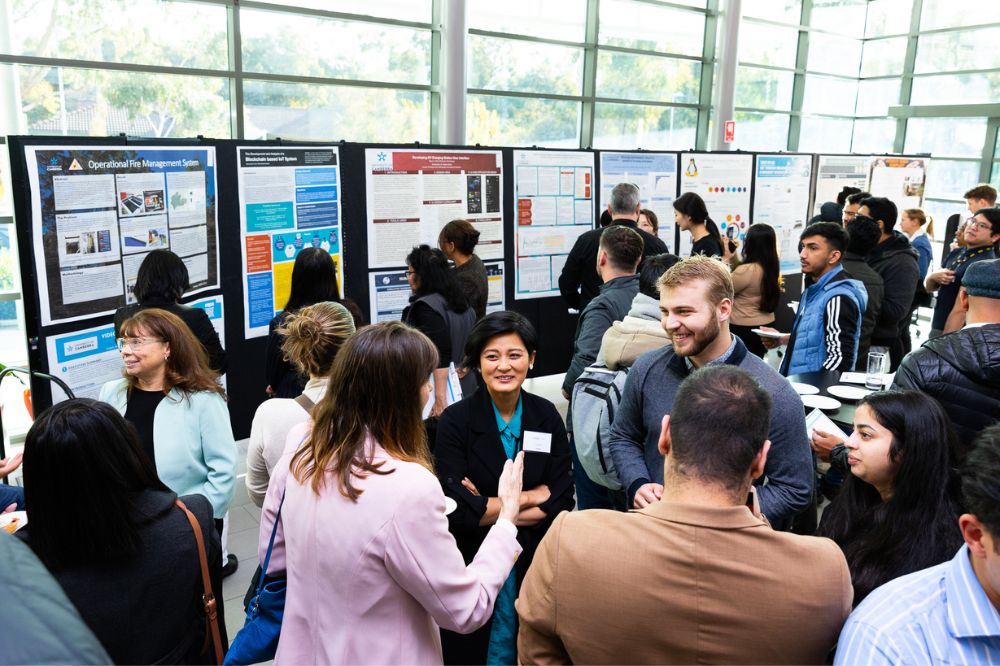
Each year, achievements are showcased at the Capstone Expo, where students pitch solutions to peers, sponsors, and industry guests. Co-judging by the Australian Computer Society ensures alignment with accreditation standards and adds external credibility.
Alumni often return as mentors and guest lecturers, closing the loop and sustaining a cycle where today’s students become tomorrow’s guides.
Innovation in Program Design
Capstone stays relevant through continuous innovation. Students are not only producing solutions for partners but also developing the habits of reflective professionals. Weekly reflective journals enhance their critical thinking and self-assessment, linking academic concepts to lived project experience.
A formal well-researched peer evaluation process underpins accountability: students confidentially assess each other’s effort, collaboration, and contribution, with results shaping individual marks and building transformative teamwork skills.
The workplace is also brought directly into the classroom through guest lectures from government and industry leaders, exposing students to real-world challenges and leadership perspectives. Combined with dual mentorship and co-designed projects, these elements create a learning environment that mirrors professional life - authentic, challenging, and supportive.
Tangible Impact and Ripple Effects
The program’s impact is visible across multiple levels, creating direct and indirect outcomes for students, industry partners, the university, and society. These outcomes showcase how ACEEU Standards, Education and Service Alignment - the deliberate integration of curriculum design, assessment, and learning outcomes with real societal and industry needs - creates sustainable value through long-term university-ecosystem engagement:
For students: Graduates enter the workforce with real-world achievements, the confidence to handle complex problems, and professional networks that often lead to employment. The valuable project learning strengthens their CV and employability.
For industry partners: Sponsors gain fresh perspectives and innovations, while junior staff develop leadership skills through mentoring. Under a university IP agreement, partners can use project outcomes at no cost for current and future work.
For the university: The Capstone has reshaped UC’s engagement profile, with student teams winning recognition at the AIIA iAwards and entrepreneurship competitions. The program has also been recognised: UC Teaching Award (2024), national commendation at the Engagement Australia Excellence Awards (2024), and the 2025 Global Triple E Award for Community Engagement Initiative of the Year.
For society: Projects leave lasting value - from protecting endangered wildlife to supporting women entrepreneurs through socio-technical solutions.
Conclusion: Building Futures through Engagement
The Capstone Program demonstrates how a carefully designed curriculum embedding authentic engagement transforms outcomes. Students graduate with confidence and capability, employers gain innovation and talent, and communities benefit from practical solutions. Showcase events like the Capstone Expo amplify impact, anchoring networks across sectors.
In this article, we have shown how Capstone closes the skills gap by putting students into real partner projects with shared ownership and dual mentorship. We’ve also shown how assessment design matters - reflection, peer accountability, and public showcases help students build professional judgement, teamwork, and confidence.
For higher education leaders, the takeaways are clear. Embed authentic, long-term projects, not simulations, into the curriculum. Build a model that lasts by sharing ownership with partners, mentors and alumni. Keep refining assessment so it integrates reflection, accountability, and cross-cultural experience. Then make outcomes visible so networks deepen and new opportunities follow. These practices reflect ACEEU’s standards of Education and Service Alignment, demonstrating how engagement and entrepreneurship function as core elements of the university’s third mission.
If we are serious about the skills gap, the challenge is to embed industry, government and community partnerships in curriculum and practice - so education becomes not just preparation for work, but a driver of change.
Acknowledgements
Associate Professor Ahmed Imran is Co-Convenor of the ITS Capstone Units and founder and leader of the interdisciplinary Research Cluster of Digital Inequality and Social Change (RC-Disc) at the University of Canberra (UC).
Associate Professor Richa Awasthy is Co-Convenor of the University of Canberra’s ITS Capstone Units, leading unit delivery and stakeholder engagement. She is a passionate educator dedicated to enhancing students' learning experience in collaboration with industry.
Bibliography
World Economic Forum (2025) The Future of Jobs Report 2025: Skills Outlook. Available at: https://www.weforum.org/publications/the-future-of-jobs-report-2025/in-full/3-skills-outlook/;https://www.weforum.org/publications/the-future-of-jobs-report-2025/in-full/3-skills-outlook/ (Accessed: 26 October 2025).
Australian Computer Society (2025) Digital Pulse 2025: Today, meet tomorrow. Available at: https://www.acs.org.au/campaign/digital-pulse.html;https://www.acs.org.au/campaign/digital-pulse.html (Accessed: 26 October 2025).
Sachs, J., Rowe, A. and Wilson, M. (2017) Good Practice Report – Work Integrated Learning (WIL). Available at: https://ltr.edu.au/resources/WIL_Report.pdf;https://ltr.edu.au/resources/WIL_Report.pdf (Accessed: 12 January 2026).
University of Canberra (2025) Reconnected 2025–2027: Defining a modern University of Canberra to deliver lifelong learning and research with impact. Available at: https://www.canberra.edu.au/content/dam/uc/documents/about-uc/strategy/connected/UCCOR0899_Reconnected-launch-document_A4_250811_DIGITAL_sml.pdf;https://www.canberra.edu.au/content/dam/uc/documents/about-uc/strategy/connected/UCCOR0899_Reconnected-launch-document_A4_250811_DIGITAL_sml.pdf (Accessed: 13 January 2026).
Keywords
Capstone Learning
Industry Partnerships
Student Employability
About the author
Jeanette Cotterill
Senior Lecturer in Government Informatics and Senior Mentor for the ITS Capstone Units at the Faculty of Science and Technology, University of Canberra.
Jeanette Cotterill is a Senior Lecturer in Government Informatics and Senior Mentor for the ITS Capstone Units at the Faculty of Science and Technology, University of Canberra. With a background in public sector program management, she focuses on building strong engagement across industry, government, and community partnerships while supporting students through their Capstone journey. Jeanette is passionate about helping students develop professional confidence, teamwork, and problem-solving skills as they deliver real-world solutions that make a genuine impact.