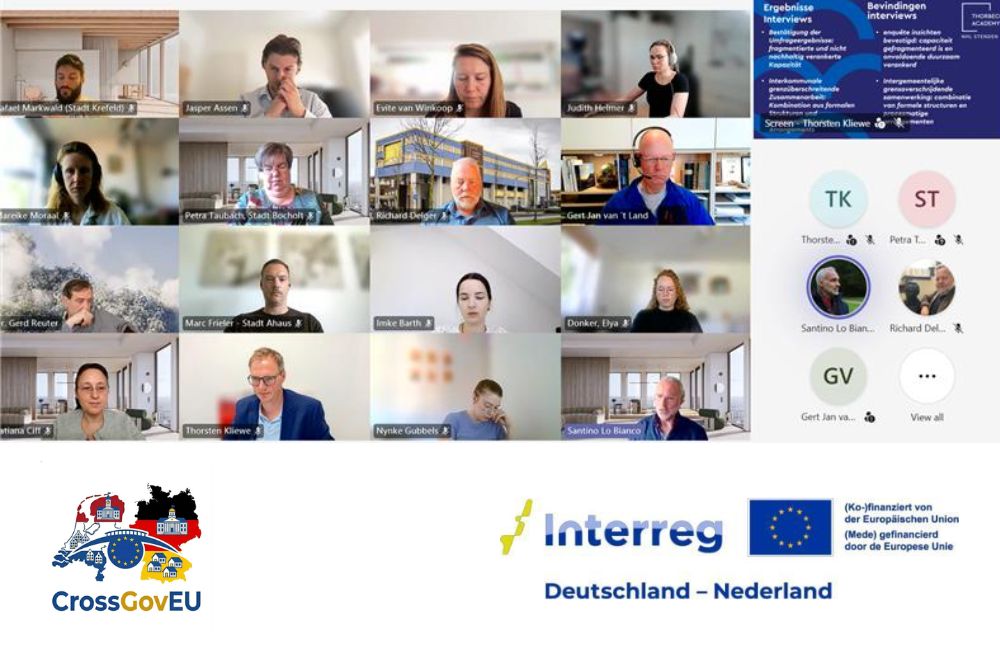
On 19 June, professionals involved in cross-border cooperation in the German-Dutch border region came together for an online exploration workshop as part of the CrossGov EU project. The workshop aimed to validate and enrich the project’s research findings while also moving from analysis towards practical design. Participants reflected on the main challenges municipalities face in organising cross-border cooperation and discussed possible intervention pathways for strengthening cooperation in the region.
The session was structured around three design goals: strengthening municipalities’ internal capacity for cross-border action, improving intermunicipal cooperation across the border, and promoting stronger engagement with local communities and regional stakeholders. To support broad participation, discussions took place in separate English- and German-language breakout groups, followed by a plenary exchange.
A key outcome of the workshop was the recognition that cross-border cooperation requires both practical action and stronger organisational embedding. Participants highlighted the importance of connector roles within municipalities, stronger use of cross-border network organisations, low-threshold activities for stakeholder engagement, and clearer involvement of administrative and political leadership.
The workshop helped identify concrete directions for a possible follow-up phase, focused on developing and testing practical interventions together with municipalities and regional stakeholders. In this way, the session marked an important step from understanding existing challenges towards designing more sustainable forms of cross-border cooperation.
ACKNOWLEDGEMENT
Das Projekt „CrossGov EU“ wird durch das Interreg-Programm Deutschland-Nederland sowie seinen Programmpartnern ermöglicht und von der Europäischen Union (EU) kofinanziert.
No website found.