

Universities across Europe, Africa, and Asia are increasingly redefining their societal mandate. Beyond teaching and research, higher education institutions are now expected to act as civic anchors-advancing inclusion, equity, and sustainable development. Gender equality, recognised under the Sustainable Development Goals of the United Nations, remains central to this transformation.
The UNESCO Education for Sustainable Development roadmap further emphasises that universities must embed equity and social responsibility within institutional culture, not treat them as peripheral projects.
Mission Shakti, a women’s empowerment initiative implemented in Uttar Pradesh, India, provides a compelling case of how public policy can be translated into sustained institutional practice. At JSS University, Noida, the initiative evolved into an integrated engagement model combining academic knowledge, student leadership, governance reform, and community outreach.
The experience offers lessons relevant far beyond its regional origin and highlights how universities can embed engagement and inclusion into their core mission, in line with ACEEU standards on Institutional Commitment and a Culture shaped by participation, equity, and shared responsibility.
From Policy Compliance to Institutional Commitment
Many universities respond to policy mandates through short-term events. The difference at JSS University was structural integration. Mission Shakti was incorporated into academic planning, student welfare, and outreach activities, ensuring continuity rather than episodic engagement and administrative and academic leaders actively facilitated programmes, signalling institutional priority rather than symbolic endorsement. This shift from compliance to commitment strengthened sustainability and credibility, through intersecting interventions:
By combining these dimensions, the university adopted a systems-based approach to empowerment rather than a single-issue model, an approach that resonates strongly with ACEEU’s standard Institutional Commitment by embedding inclusion, participation, and shared responsibility into everyday institutional practice.
Empowerment initiatives often falter without administrative continuity. A critical success factor here was governance integration. Academic departments, student welfare units, and administrative offices collaborated in programme implementation and activities were linked with broader institutional quality and engagement strategies.
Student Leadership as a Multiplier of Impact
A defining strength of the initiative was active student leadership. Through cultural societies and student organisations, learners developed creative engagement strategies using poster campaigns, photography storytelling, slogan writing and street theatre performances. The student-led play Udaan (“Rise”) translated gender challenges into relatable narratives, encouraging dialogue in open campus and community settings.
Such participatory formats achieve three outcomes simultaneously:
Across continents, experiential learning has proven effective in addressing complex social themes. The initiative illustrates how cultural platforms can deepen institutional impact.
This alignment resonates with frameworks promoted by the European Association of Engaged Universities, which emphasise structured third mission activities and engagement-oriented culture. When governance systems support social initiatives, impact extends beyond individual champions.

Linking Science with Livelihood: Skill-Based Innovation
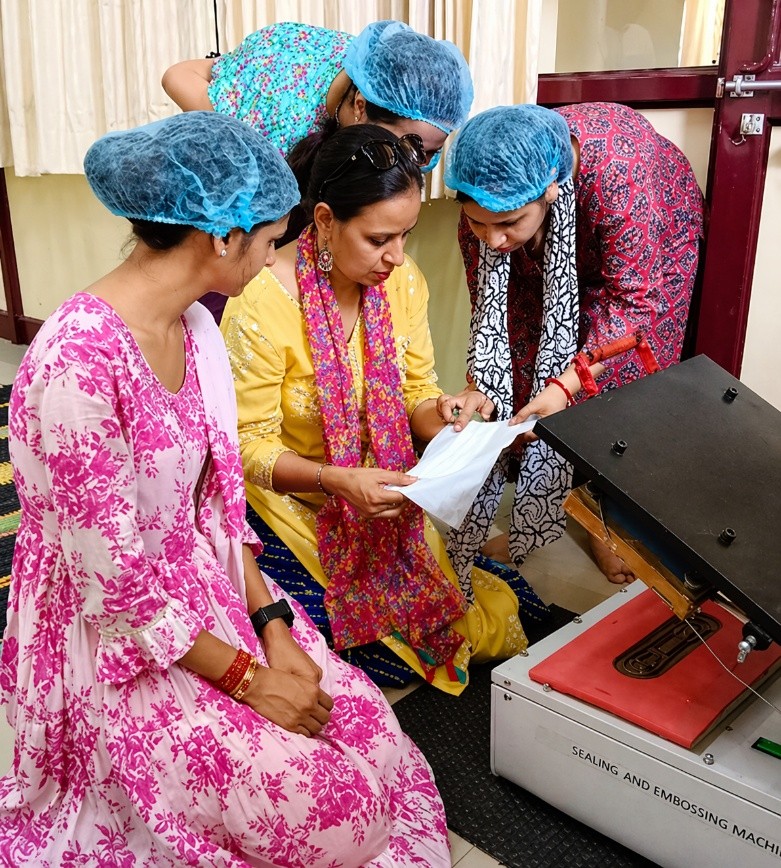
Another flagship initiative under Mission Shakti was a low-cost sanitary napkin production programme implemented through the Women Skill Centre. Participants learned material selection, absorbent layer preparation, sterilisation, and packaging, ensuring product quality and practical competence. Sessions on menstrual hygiene management linked production skills with health literacy, which transformed to the entrepreneurial orientation, as basic cost analysis and marketing principles encouraged participants to explore micro-enterprise opportunities.
More than 250 women and students were trained. Importantly, the model was designed for replication through community networks.
This approach demonstrates how applied university knowledge can address both health accessibility and income generation-an especially relevant model for resource-constrained regions across Asia and Africa, while also aligning with social innovation practices in Europe.
Building Safe and Trustworthy Campus Environments
Notably, empowerment is inseparable from safety. Without secure institutional environments, participation remains constrained.
Over 1,000 students engaged in structured awareness sessions focusing on:
While legal frameworks differ globally, the principle is universal: universities must move beyond regulatory compliance toward cultures of dignity, accessibility, and shared responsibility.
Institutional trust is not declared; it is built through visible systems and informed communities. Across continents, experiential learning has proven effective in addressing complex social themes. The initiative illustrates how cultural platforms can deepen institutional impact, which is connected to ACEEU standard Culture.
Transferable Lessons for Universities Worldwide
The Mission Shakti experience offers adaptable insights for universities worldwide:
For institutions in emerging economies, low-cost skill models can address immediate development gaps. For universities in advanced systems, structured engagement strengthens civic legitimacy and societal trust.
Conclusion: Universities as Engines of Inclusive Transformation
Higher education institutions possess intellectual capital, social credibility, and youth dynamism. When these assets are aligned with leadership commitment and community engagement, universities can become powerful engines of gender equity.
Mission Shakti at JSS University illustrates that meaningful empowerment requires more than awareness-it demands integration, participation, and sustained institutional will.
The broader implication transcends geography:
When universities embed equity into governance, curriculum, and culture, they move beyond campus boundaries and contribute actively to inclusive social transformation. In doing so, the article reinforces ACEEU standards Institutional Commitment and a Culture rooted in inclusion, participation, and shared responsibility.
Acknowledgements

Tejas Baranwal
Cultural Team Coordinator, Kalakriti Society, JSS University, Noida, India
Tejas Baranwal is the Student Coordinator of Kalakriti, cultural Society at JSS University, Noida. He synchronizes cultural and socially engaged initiatives addressing contemporary societal issues, leveraging performing arts and creative platforms to foster youth participation, community dialogue, and inclusive social awareness.

Sonali Verma
Student, EE, JSSATE, Noida, India
Sonali Verma is a third-year Electrical Engineering student at JSSATE, Noida. She contributed as a Master Trainer in a sanitary napkin skill development program, supporting participant training, menstrual hygiene awareness, and sustainable practices, while developing leadership and community-engagement skills through hands-on social initiatives.
Bibliography


.
Images courtesy of the author